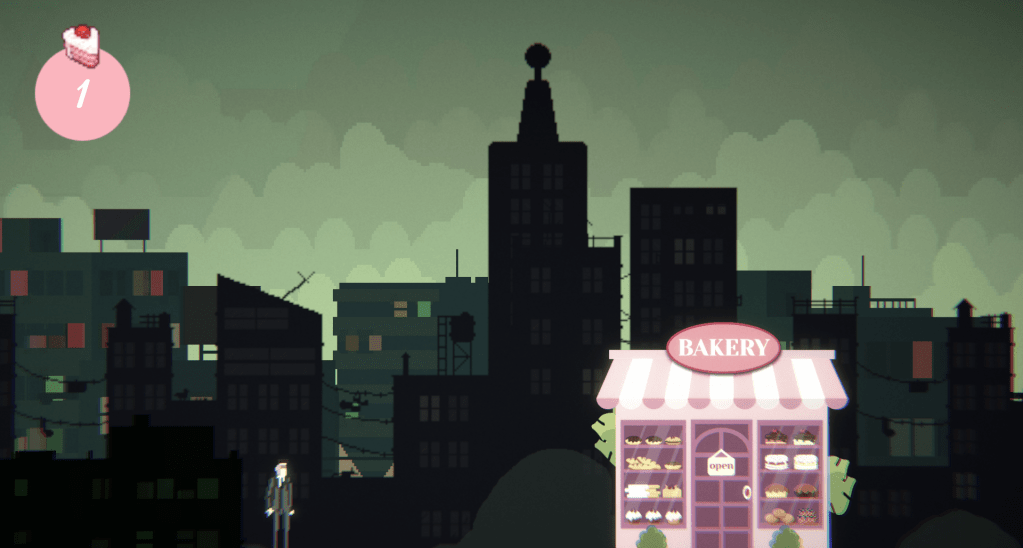
What were we trying to accomplish and what did we do to pursue the goals we set for ourselves?
Our prompt for the project was to make a game based on a proverb. The intention was to push us in a more explicit direction with our work, to communicate more clearly a specific perspective in our art. In ideating, we shifted the approach towards exploring what we called “Internet proverbs”, or widely accepted pieces of knowledge or advice either related to or widely shared on the internet. Because these are generally less explicitly defined, we decided to codify our own proverb and base the game on that. Beyond just creating a game that loosely discussed a proverb, we knew that we wanted a more pointed experience, so we updated the prompt to: Judge an internet proverb and its context.
After a long ideation process of creating and evaluating different internet proverbs, we settled on the idea of the treat economy. This is a trend in which mostly Gen Z in the modern western world approach their day-to-day lives through the lens of having treats. In a society that can often be characterized by instability, anxiety, and burnout, Gen Z often turns to little “treats”, from an iced latte to a new pair of shoes, to get through the day. The justifications often revolve around having “earned” a treat: either “I had a tough day today, I deserve a treat” or “I did a good job today, I deserve a treat” (and quite frequently both). For more background information, this article discusses this trend in depth.
Our approach to the prompt through the lens of the treat economy was to identify and express the fact that treats are merely a symptom of a deeply broken system: capitalism has created a world in which treats are a requirement for getting through the day. We were hoping to focus less on criticizing an individual’s reliance on treats and instead criticize the system that creates this need in the first place. As such, we created a game with minimal decision making and a focus on monotony and environmental expression: much of what occurs in the game happens to the player as they just try to make it from point A to point B.
We knew that a great deal of the commentary in the game would be focused around the experience of consuming a treat: both in terms of what it feels like to have a treat as well as what it feels like to avoid them. We created a system in which moving without treats feels oppressive and harsh, and the only way to restore any semblance of comfort is to have a treat. The effect of eating a treat itself was made to feel as game-y and light as possible, which was intended to have an almost gross quality when contrasted against the other darker aesthetics.
The ending of the game was also designed to speak to the monolithic and inescapable nature of the society that created the treat economy. The idea is that even an attempt to escape or defy the system is commodified and sold in itself, removing any sense of agency to participate or not. In addition to this specific commentary, the ending we chose comes from our goal of creating a more biting and bold commentary in our work.
What is the game?
TRIGGER WARNING: References to suicide.
The game opens to a title card with the phrase “A little treat goes a long way”. It fades in on a two-dimensional green cityscape with the main character standing on the sidewalk. The player presses space to move forward one step at a time. As they walk, the world gets overwhelming: there is a dark vignette that closes in around the player, the city ambient sounds grow distorted and loud, and the character moves less and less every step. The player can hold down enter to eat a “treat” clearing all of the effects and returning them to a more normal state. As the character moves through the world, they pass bakeries which add an additional treat to their inventory. If they walk too far without consuming a treat, they die. After walking for a while, they come up to a sign that reads “One Last Treat Euthanasia Clinic”. Upon reaching the sign, the game fades to black and the treat sound is played one last time before the game quits.
Austen Reflection
I felt good about this after playing it myself. There’s some juice, polish, and angst – what more could you possibly want out of a game. I felt less good about this after watching Peter play. After having made this, we spoke as a group a bit about the audience (and didn’t really come to any conclusions), but we are finding ourselves up against the question of inward or outward facing art. I tend to be incredibly self-indulgent when it comes to all of the art stuff we make because I want to make games about stuff I care about. On the other hand, after talking as a group, I am focusing a bit more on trying to understand what it means to be making art for an audience. I am personally undecided on exactly how I want to incorporate or not incorporate the idea of a player in our production process, but David made a good point in saying that people don’t play stuff that isn’t fun. Fun is an incredibly elusive thing to define, but as a working understanding we are saying that if you don’t like pushing the buttons you press, you’re probably not going to play. Now that can still be in the context of not liking the result of your button presses, but if you don’t understand what the spacebar does and how to use it, you don’t get to engage with any of the meanings we’ve hidden in the spacebar. This is honestly a bit of a hard to swallow pill for me, and I don’t think I’m quite done thrashing against it, but I am running out of ideas on how to subvert the expectation on me as a developer that I need to be considering the other player’s experience as I make things. I will say, from my self portrait, I have learned that there is value in making something where I only consider myself as the player, but now comes the work of figuring the balance as I do not intend to spend my life on making purely self-indulgent art.
David Reflection
In my opinion, this project was cooler in theory than in practice. The idea of making a game about the unbearable weight of modern reality that is only lightened by superficial short-term rewards is an incredibly bleak yet resonating theme. With the right care and time put into it, I think we could have created a really thoughtful game about the gnawing experience of corporate America. However, I think this game ended up being something that could have been summed up in one sentence… “life sucks… damn”, which is admittedly a little disappointing for me. I think that art for the sake of expression is really important, and it is okay for us to make a game about the bleakness of reality as we go through our “oh no we’re graduating soon” crisis. Art is a great way to vent our emotions (I do it very often), however that also means that sometimes the art created by this process may not hold much beyond whatever was vented, and may not be interesting for others looking at it. I think looking back on this project, I have a much clearer understanding of what it means to make games for ourselves versus others. This was our vent game, and I’m glad we made it. The way I understand it is that this was a game for us, not a game for others. The level of polish we reached with this project is something that I am happy with. I’m also pleased with how pointed we were able to make this project. It is undeniable that this project is about something, which honestly is a win in my book. It is often too easy to make a project about everything, and therefore nothing.
Zach Reflection
I really like this game, I think it’s sitting in a place that I’m actually pretty proud of. It’s kind of difficult to tease out exactly why, there’s a part of me that thinks it’s because of the “polish” that we were able to add to it. It feels like we were actually able to fully implement the core of the game with all of the effects around getting tired and then having a treat. After a lot of projects that just don’t end up communicating much on their own due to time constraints, it’s very refreshing. This game came from a place of really wanting to artistically discuss the culture we live in and a perspective we have about the future, so it was even more satisfying seeing it working. As we move deeper into the Thesis, I’m really enjoying how we’re allowing our ideas to become more expressive and personal, I’m finding a ton of meaning and excitement when approaching our games from that place.
Takeaways and Postmortems
As mentioned above, we were really trying to reach a new level of clarity and pointedness that we haven’t seen in our projects before. We believe we were able to meet this goal considering our play sessions successfully communicated the general ideas that we were trying to present. This is largely due to the simplicity of the idea: the main point was that the monotony of life in this system is inevitable and that treats are not a sustainable solution. Having the proverb included at the beginning of the game also definitely helped with this; in the past, we have been much more hesitant to include words or commentary in the game itself, but the proverb primed the player for the experience well. We weren’t able to fully communicate the depth of the idea in the short project, but the core identity of the rhetoric was communicated.
One important piece of feedback we received was that the ending feels somewhat passive and disconnected from the core gameplay loop. Part of the tension in making any change to the ending is the fact that agency (more specifically the lack thereof) is a core piece of the ending’s meaning, so giving the player much choice here does muddy the game’s rhetoric. That being said, there are ways to make it a bit more interactive and embodied without losing the inevitability of the outcome that we would absolutely explore in iterating on the project.
More generally speaking, this was one of our first forays into a more “serious” prompt as a group. The game started with our emotions, coming from a place of frustration with the system that we find ourselves having to live and work in. We quickly agreed that we could approach the game as a kind of vent, a space for us to express some of this pessimistic frustration without needing to wrap it up nicely or find a positive spin on the situation. This definitely gave more meaning and connection to the process: it felt very artistic and emotional as opposed to some other projects that have felt more cognitive and experimental.
We were also quite happy with our approach to adding “polish” to the game. We saw a clear need for an amount of juice features and cleanliness in presenting our ideas effectively, and we scoped the game well to be able to focus on the effects that we really needed. After the project, we left with a bit more of a sense of completeness than we have with a lot of our projects. As we move into larger and more dense games, valuing this cleanliness of presentation will serve us well.
Finally, as it was discussed above in the reflections, it is important to consider the outward presentation of this project to an audience that extends beyond the three of us. This project was very cathartic for us, but lacks the same emotional resonance for players, and this is something that we care deeply about continuing to develop and explore. We made a step forward here in terms of the clarity of communication, and now we can continue to move towards creating games that sit well and generate valuable meaning for players in addition to just communicating their intent.
 Art Games Thesis
Leave a comment