What were we trying to accomplish and what did we do to pursue the goals we set for ourselves?
Our prompt this week was to create a transgressive game. This prompt came about because of a conversation we had with our faculty advisor Peter during our bi-weekly meeting. We were discussing the topic of transgression and how it has changed throughout recent history. By assessing the popular transgressive topics of each passing generation, we were given a new lens to view the cultural shifts between generations. This was also a way of looking at cultural analysis that was new to us and one that we found to be deeply fascinating. Naturally, the question arose regarding what we found to be transgressive, and what transgression looks like in games.
This project was quite challenging for us during ideation. To start, we knew we didn’t want to equate transgression with harm. We were not interested in creating experiences with the express intent to harm our players just for the sake of it. We also didn’t want to be transgressive by disrespecting cultural groups or the identities of others. Essentially, we wanted to be transgressive without being harmful. With this in mind, we discussed various options for how we can be transgressive and what topics are transgressive by nature. We landed on the topic of introspection, self awareness, and growth which can feel quite transgressive on an individual level. We wanted to focus on the question of whether an individual is introspective and the transgressive nature of that question. More specifically, we landed on the topic of introspection in relation to an individual’s biases and privileges. It is difficult to recognize one’s biases and privileges, and that process can feel quite transgressive.
Our goal for this project was to create a situation that encourages individuals to be actively introspective on their own accord. In doing so, we hope the players will recognize the hidden imbalance in the game’s system and work together to resolve it. How we planned on accomplishing this goal was to put players against one another in a seemingly fair competition of dexterity, when in reality the system is rigged in one player’s favor. We leave hints in the game that suggest this, but leave it up to the players to discover and recognize the game’s biases for themselves. We tap into the innate competitive nature of most video game players, and ask them to put that aside for the sake of introspection in order to recognize the innate unfairness of the game.
What is the game?
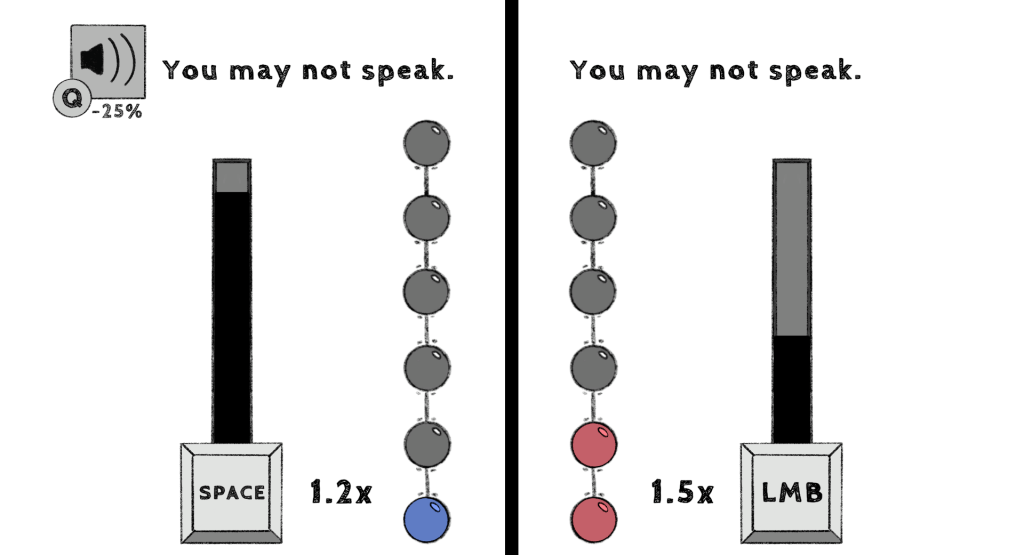
Click Racer is a rigged clicker game where one player naturally progresses faster than the other, however, we present it as a fair competition. The goal is for the players to realize that the game is rigged, and for the player with the hidden advantage to help the disadvantaged player win in order to reach the true ending.
Game details:
- Fill five bars to win the race
- Players may not speak to each other, unless they spend 30% of a bar to purchase five seconds of speaking time
Player 1:
- Spam spacebar to fill bar
- Every bar that is filled increases how much each click adds to the next bar (1x, 2x, 3x, 4x, 5x)
- Press Q to purchase time to speak
Player 2:
- Spam left mouse click to fill your bar
- Every bar that is filled increases how much each click adds to the next bar (1x, 2x, 3x, 4x, 5x) this is a lie
- P2’s multiplayer secretly is higher than P1’s, making it almost impossible for P1 to win (in most cases) this information is hidden from the player
- Press right click to purchase time to speak
- P2 can move their mouse to click on P1’s button to help them fill it (this mechanic is hidden and not explained to the player)
Austen Reflection
To be frank, this was rough (again). Ignoring what we made, the topic of transgression – even if it’s artistic and ‘good’ and helpful [maybe] – makes me super uncomfortable. I have such a strong association between transgression and intentional harm of vulnerable people (which I don’t like in case that’s unclear), and creating a piece of media or making a space that is transgressive needs to toe such a particular line… While I’m thankful that we spent a lot of time digging into how to go about transgressing in a way we could justify, I’m not sure we ended up with something super transgressive. And I do think that this may have been in part because of how hesitant I (and my co-transgressors, but they can speak for themselves) was to throw caution to the wind and just go make something upsetting. I think we’re also falling into a habit where we avoid things that are cliche and on the nose, which really restricts our output given the timescale of these projects. As per usual, I’m sort of just trying to come to terms with why I don’t really like what we’ve made (which is part of the point of this phase of the Thesis, and failing is ok, and I definitely learned a lot, and I gained a bunch of new vocabulary and that’s valuable, but it is hard to look back and to just feel a little miffed and disappointed when looking at the executable that we end up with).
David Reflection
Looking back on this project, I think the initial direction we took with this game had promise, but in the end it didn’t quite land. The idea of a rigged core system being masked by a facade of equality is a really interesting context, and I think has great potential. However, I don’t think the direction we took made the best use of that idea. To start, Click Racer relies too heavily upon very specific assumptions we make about our players. The game will only land if the players are invested enough in the game to pay attention, it will only land if players believe they have relatively similar clicking capabilities, and the game will only land if players believe all parts of this game are fair. In most cases, these conditions will not be met. I also think we could have done a better job communicating the point that the game is trying to make. Despite these criticisms, I believe we learned a lot from this project and I am proud of how it came together. Despite the difficult production, we still managed to put together a relatively polished game.
Zach Reflection
It’s tough to summarize how I feel about this project, there’s a lot of conflicting feelings here. On the one hand, I think the conceptual design work that we did was very interesting and exciting. I am really proud of how the game theoretically expresses an artistic point about inequality through the core systems, and the thought that we put into the meta play experience of the game (how players will figure out that it’s rigged, controlling how they communicate with one another, etc.) was really interesting to me. On the other hand, I don’t think the game itself really communicates much of this. We’ve been taught to understand that the practical play experience of a game is all that matters and that theoretical design doesn’t hold much weight unless it works as intended. In these short little sketches of games though, it’s important for me to keep learning how to find the value in the work that we are doing on ourselves and in our own processes as artists rather than only seeing the final product. It takes time to get used to this, but that’s exactly why we’re making these short projects.
Takeaways and Postmortems
After finishing the project, our immediate concern was that of clarity. Part way through development we realized that the difference in control scheme between the two players (mouse versus space bar) had a larger impact on the experience than we expected. Click Racer relies on creating a facade of fairness, but if that facade is not concrete then it can be quite difficult to realize that the game is rigged. In the case of control schemes, the space bar and mouse had differing affordances which could lead to the players attributing the unfairness of the game to the control scheme rather than questioning the system. We want the players to be introspective and come to the realization that the game is rigged, but the differing control schemes get in the way of that. It’s difficult to discern whether someone won because they were using the better control scheme, or if the game was rigged. On a similar note, player skill and mentality were also big factors. Depending on the players, many may not realize that the game is rigged and simply attribute a win/loss to the difference in skill. The game itself doesn’t provide a strong enough incentive for players to get invested and therefore players simply may not care enough to question whether the game is rigged or not. Although we attempted to balance the game such that it would be relatively obvious that the game is rigged, it can still be quite hard to notice, especially if players don’t care enough to pay attention to it. These were factors that we discussed throughout the development of the game, but with such a short development timeline, we were not able to iterate and come up with solutions. We tried our best to tweak and balance the game in such a way where these issues were hopefully less apparent, but weren’t able to remove them completely.
On a different note, it is unclear whether we accomplished our goal of transgression. The fact that became apparent after we had Peter test the game is that the transgression only surfaces with any meaningful strength if the players are both invested in the game and already assume they are on similar skill levels. If one or both of those requirements are not met, then there is little transgression perceived by the player. We hoped to tap into the competitive nature of players, but in doing so we also made that a requirement. Click Racer has the potential to be a very transgressive game when placed in front of the right people, but will not land quite as well otherwise.
Outside of those criticisms, we were quite happy with how the game came together. The development process was slower than some of our other projects due to the challenging prompt. However, we still managed to produce a relatively polished game in the end. Through our ideation and discussions, we also learned a lot about tackling challenging topics through our games.
 Art Games Thesis
Leave a comment