What were we trying to accomplish and what did we do to pursue the goals we set for ourselves?
Our goal for this week was to create a world with an artistic purpose in mind. Compared to some of our previous projects, this project started out more casually. We didn’t have a strict topic we wanted to explore from the start, so we spent the first part of ideation coming up with ideas for worlds we could create. We eventually landed on the idea “what is/was left of your last normal day”. From there, we discussed how it would be interesting to portray how different individuals spent their final hours before some pivotal event. This brought us towards the topic of power, control, and safety. We started discussing how it would be interesting if each of the characters in the game were from a different socioeconomic background, and how that background would affect their final hours.
With the foundation of an idea in place, we then fleshed out the details of the world and characters. We thought it would be fun to set the game in a medieval fantasy town the day after a dragon’s attack. Admittedly, the setting itself is quite generic and somewhat uninteresting. However, our goal was for the characters and their relationships to draw the player’s attention, and for the setting to not be over complicated or get in the way. As such, we chose a setting that most players are already familiar with.
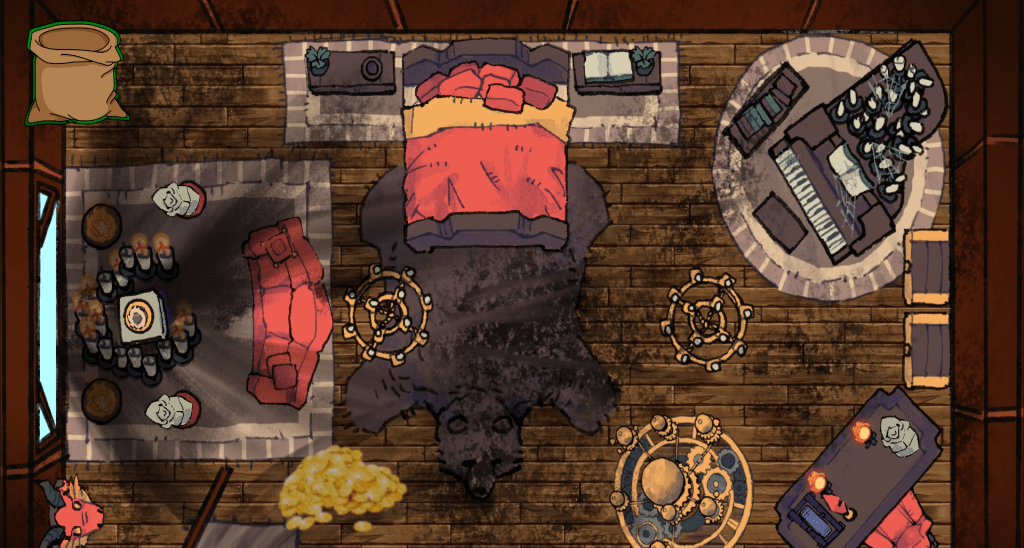
The three characters within our game are Celey, Leham, and Eswick. Celey is one of the town’s common folk, Leham is one of the town’s political figures, and Eswick is a wealthy merchant who uses his wealth to gain control over others. You, the player, are part of a cleanup crew in charge of gathering debris from the dragon’s attack. The game takes place purely within the bedrooms of the three characters. Throughout the game, you travel between the characters’ homes and collect pieces of debris. The more debris you collect, the more you discover about the dragon’s attack and the secrets surrounding it. Each piece of debris acts as a hint towards uncovering the truth.
In the end, you discover that both Eswick and Leham were aware of the dragon’s attack before it arrived. In fact, Eswick was the one who took the dragon’s egg as part of his cult activities which drew the dragon’s attention and led to its attack. Leham was bribed by Eswick to spread propaganda for his cult in exchange for money and political power. Celey was unaware of the dragon’s imminent attack, but was shown to be affected by the cult propaganda. There are various small details in each of the characters’ rooms that give context to who they were and how their socioeconomic status affected them. One such detail is how each of the characters died, or didn’t. Celey was unaware of the dragon’s approach and died while asleep. Leham was notified of the dragon’s approach, but was unable to escape in time and died close to the door. Eswick was aware of the dragon’s approach well in advance, and was able to escape the town long before the dragon arrived. This is shown through the neatly done bed and well cleaned room.
In addition, the player also learns more about the true nature of their job. At the end of the game, they discover that they weren’t just part of a cleaning crew, they were instead hired to gather evidence of Eswick’s crimes and dispose of it.
What is the game?
The Egg is a top-down narrative driven game where you inspect objects and drag them into your bag. Each object you inspect has a short description. Not every object in the rooms is interactable, and it is up to the player to click around in order to find the interactable objects.
Austen Reflection
Simply put, I don’t think The Egg ended up being all that much of anything. It’s a little buggy and isn’t the cutest, which is fine given that it’s a prototype, but it doesn’t really do much of anything. I’m writing this reflection a bit after we finished the project, so I’m maybe a bit more cynical than I would have been then, but there really wasn’t much of anything in that game. Functionally, it is fairly complete which is pretty alright. We have a simple narrative that runs through it and some loose worldbuilding which is neat for a weeklong project, but the constraint of a week really comes through here. A week to complete any game thing turns out to be incredibly tight, and after having had two weeks for my self-portrait, I’m becoming a bit frustrated with the tight timeline. We spent a decent amount of time talking about potentially lengthening our timeline, but decided that would just invite scope creep on ourselves at this point. On the topic of scope, I do think we are really starting to lock in about how much we can accomplish in a week, and I’m quite excited to use this information as a tool once we do start lengthening our timelines.
David Reflection
I think The Egg is a case where the pitch is more interesting than the product. A game about “what the last normal day looks like” is really enthralling, especially paired with the theme of power. Building a world around such parameters is an idea with legs. However, it is an idea that is too big for a single week and three developers. I believe we did the best we could given the circumstances, but the project ended up just being just lukewarm. It loosely touches on the themes we wanted it to with a generic world and one-note characters. No individual part of this game really holds up to judgement, but I’m still happy that we finished it. Despite not quite loving the game, I’m glad to see that we are still able to push through and finish out a project to this quality.
Zach Reflection
I’ll start by saying that I was not quite as close to this project as Austen and David, I was at a conference for the first few days and wasn’t present for the core ideation. That being said, this was a great exploration into depth of communication in art and the specific challenges that we face when making games. We tried to make things as obvious as we could and still ran into a lot of clarity issues with bugs, unimplemented features, and other oversights, so moving forward we are going to try to keep pushing our communication further. This was also a good opportunity for me to explore something that we’ve spoken about a fair bit in the past: how do multiple people all take ownership of a creative project? Because of where I sat in the process, I took the advice of a professor of ours and found a piece of the project that I could take some real ownership of and lean into that. Instead of trying to insert myself into the worldbuilding and narrative development process, I dug into the programming for the project and found ownership in the creation of the systems. It helped me to feel like a part of everything, even though I wasn’t there for the main ideation, and that’s an important skill to have when art creation isn’t always linear and clean.
Takeaways and Postmortems
Looking back on this project, we believe that it was a relatively successful game considering the context of its development. We were feeling pretty low energy coming into this project, and Zach was also away at a conference during the ideation phase. We also started off with less concrete of a direction than we usually do. Building a world within a week is a very tall order, especially considering we also decided to create a narrative along with it. For projects of this length, we do not have time to create art assets by hand, and we primarily are forced to rely on assets we find online. This greatly limits the scope of what we can do with world building. The theme we tried to explore through the narrative was also a little undeserved. We wanted to explore how imbalances in power can manifest tangibly in people’s lives, which admittedly is quite an ambitious theme to tackle alongside the other ambitious aspects of this project. In the end we ended up with a decent game that touches loosely on themes of power, but doesn’t have the bandwidth to meaningfully explore them.
With that said, we were quite pleased with how the technical aspects of this project came together. Finding art assets was challenging, but in the end we were able to create a cohesive collage using the images we found. No singular aspect of this project could really be considered noteworthy, but we were still happy with the baseline level of production each aspect reached. When looking at The Egg, no individual aspect of the game really holds up under scrutiny, but when looking at it cohesively it could be considered the start of an interesting game tackling the theme of power.
 Art Games Thesis
Leave a comment