What were we trying to accomplish and what did we do to pursue the goals we set for ourselves?
For the first time, we abandoned our list of prompts and questions. Each of our previous projects had either a prompt or question to begin our discussion for what to make, but at this point in the semester we were starting to feel the impulse to make art about something we all cared about. The distinction might be small, between discussing what we wanted to make art about vs. discussing a prompt that would allow us to explore artmaking in games, but this difference allowed us to draw on what we had learned over the course of the semester to really dig into collective art-making. We opened up a spreadsheet and fell into what at this point had become a regular rhythm of ideating and eventually started talking about hyperreality. While there were game ideas in that spreadsheet, instead of picking a game idea we ended up choosing “make hyperreality” as our starting point.
Our Hyperreality:
Accepting a hyper reality is accepting that reality is not known, that life is mediated by abstractions, not source; we are expected to vie for, kill for, love for our unknowable abstractions. As designers, as artists, as people, the three of us are regularly disoriented by the expectation of a known reality. Regular is the cycle of scrolling from war to love to mantra to beauty, leaving a fleeting sense of horror of longing of conviction of awe. This part of hyperreality comes as sure as breathing to our peers and superiors, but we found ourselves desperately lacking insight and acknowledgement of this all-encompassing phenomena. In our experience, our world is hyperreal, has been hyperreal, and will forever be hyperreal, given consciousness, given the ability to communicate, given life. As I write this post, we have already decided to spend the next semester engaging the subject of hyperreality in our making. Here I will try to explain where we’ve placed our starting line.
Unlike our other projects, we decided that the core mechanic of whatever we make does not need to entirely represent the idea we were working with; rather, the mechanics can be metaphorically connected and the game can be about the idea (instead of the mechanics being the idea, as we had previously attempted). We arrived at this sort of goal, sort of constraint by discussing how other games that are clearly engaged with artistry play and found that the most compelling experiences were those where the core mechanic was fun or engaging first and foremost. Again, unlike our previous projects, we decided to be on the lookout for conventions that were tried and true to base our gameplay in, as opposed to reinventing the wheel.
We also spent time talking about other media that touched on the concept of hyperreality we wanted to highlight, the Library of Babel being one of the primary things we discussed. Also unlike our previous projects, we brought our concept of this game to Peter before we actually opened a Unity project. We spent time discussing the values of postmodern art and how different periods of art have different guiding questions and themes that seem to present themselves. In preparation for that meeting, we spent almost an entire week unpacking the concept of hyperreality, creating shared vocabulary between the three of us, and designing a space that was representative of our ideas. One of the fundamental axioms we established was that hyperreality is not a new phenomena and that reality has been hyperreal for humans as long as there has been a human experience. The thing that is new is the scale at which hyperreality operates and the volume of information one is expected to take as reality. The expectation to conceive of our hyperreality as reality is also not new. These were concepts we wanted whatever we ended up making to assume and communicate.
During that first week of the project we started to work on the concept of the space the player would inhabit and design the character of the space. We ended up settling on some merging of the ideas that come with the Library of Babel and the story of the Tower of Babel from the Bible. We talked about making a space that contains every permutation of information conceivable and the pursuit of some larger Truth, God, or Reality (whatever you’d like to call it – we decided to call it the Tower). Making a game where every possible permutation of experience can be had is obviously a little far fetched to make in three weeks, so we reduced the scope and decided to build something that would be in a tower, that is a library of everything ever forever (ish). We further narrowed scope by deciding to make two distinct spaces (instead of every space ever) and built a system that would impose these spaces on each other. In addition to the spaces, we constructed people who inhabit the Tower and developed guidelines and tropes for what it could mean to be an inhabitant of the Tower. We also settled on making the primary gameplay 3D Platforming. This decision was driven by the motivation to have the primary gameplay be something that is engaging in the context of games being things that tend to be fun and something to play.
The narrative of the space, the Tower, and the narratives of the individual characters were also something we spent a fair amount of designing and refining. As a player, you do not play as a version of yourself. Your player character has a motivation and a voice for you, the player, to court and influence. We also developed a specific mythos for the Tower, for the player, and other characters in the Tower to know of and explore.
The Player character is determined to find the top of the Tower, under the impression that this will bring knowledge, enlightenment, some kind of fulfilment – that they will be able to see the whole Tower. The idea of the Tower however, we designed as a red herring. There is no top, there is no Thing to Climb™, there is honestly barely the entity of the Tower; similarly to how we, as people outside of this game, use the word Reality to describe our faith in a persistent, knowable existence. There are characters that know about the nature of the Tower to varied degrees, some keen to climb, some acute scholars, some seeming entirely disengaged with the idea of it in the first place. The scope of the implementation of these narrative concepts is limited in this prototype, but through the characters found in the playable prototype, some of these ideas emerge through the overlapping dialogue.
What is the game?
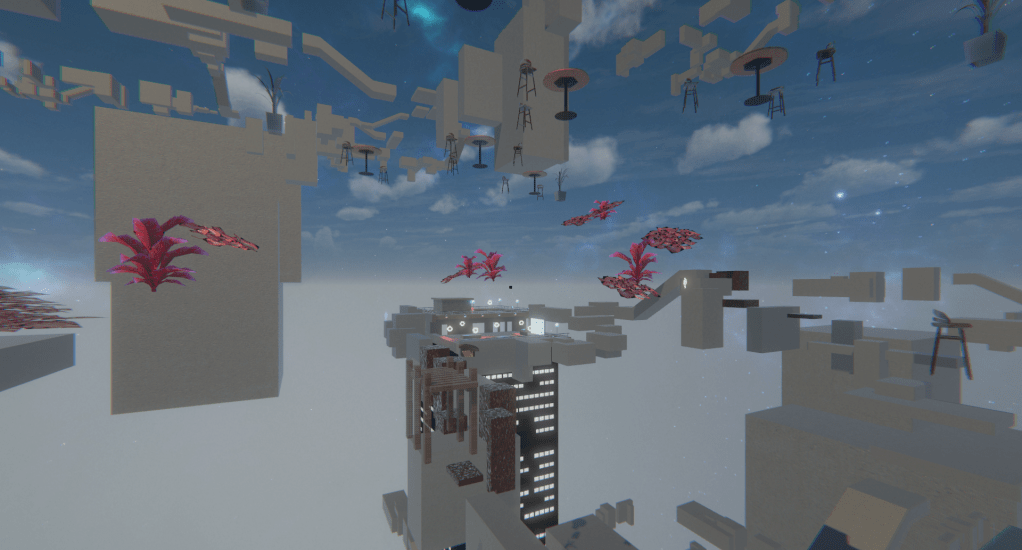
There are two distinct spaces that we made in accordance with the rules and characteristics we designed the Tower to have: a rooftop party and a calm pond. Each space represents part of a worldview and is symbolic of the values it advocates for. The rooftop party is hosted by a character who has just successfully launched her business and holds that loud silence found in a metropolitan city. The pond is a serene getaway for a character to forget about the demands of socialisation. These spaces on their own are not specifically remarkable, aside from the fact that they are representations of spaces their respective characters deeply value. We also chose these two spaces since a city and a natural location contain an inherent contrast that we expected would provide the player with an appropriate amount of dissonance in relation to our own experience with present hyperreality.
A core feature we settled on that would help distinguish the game from any regular 3D platformer is a visual effect that overlaps spaces. Essentially, each space would have a group of items that would overlay on the player’s vision, changing in scale and visibility as they moved closer and further away from the space the objects belong to. For example, as the player moves towards the rooftop, the tables and chairs dither in and become more solid; however, the rocks and plants from the pond remain present, dithered out but never gone. As the player steps into one of these spaces, the objects that were floating around from that space lock in and become solid. The objects from the other space still float around, dithered. Similarly, the audio of each space fades in and locks in as the player approaches it; while, sound from the other space fades away but never entirely.
These spaces are connected via solid and unstable platforms and the player must platform over each space respectively. The controls are as follows:
- WASD to move
- Mouse to look around
- Space to jump + double jump
- Left control to slide (builds momentum for further jump)
If the player falls, they spawn back at the beginning.
Each of these spaces also has a character at its nexus. The player can speak to them (though the conversation is linear) and learn about them and pick up some of their values, virtues, and curses. The space also has a handful of floating, glowing orbs that display one line remarks about the scenario when clicked on. These voices fill the space but also further illustrate some of the implications and complexities that come with a worldview. The voices are loosely people who exist in that space and do not spend themselves on traversing the tower. The ambassadors of each space tend to sit in between an inhabitant of their space and a traveller of the Tower.
There are additional characters scattered throughout the platforming that range from people also travelling through the Tower to people who have more been pushed around the Tower. This spectrum exists to allow for the Tower to take on additional complexity as there are people who are aware of themselves in the context of the Tower and seek to navigate it, people who shape parts of the Tower knowingly or unknowingly, and people who exist more oblivious to the Tower and more concerned about the characters that shape the space they inhabit.
Austen Reflection
I’m writing this before I write the rest of the blog post as I have not yet analysed the optimism out of myself. I felt good playing this game and watching Peter play which is a first. Now, we did end up taking close to three weeks on this, and it shows, but the player controller feels good, the world looks interesting, the effects are cool, the space feels thought out, there’s a story and people and stakes… While Peter did not one hundred percent get the thing we were trying to communicate to the specific degree we wanted him to, he was certainly in the correct space, and I think for an attempt at representing the insanity of a hyperreality, this was a fantastic first step. Furthermore, I feel quite fulfilled artistically by the end result of this playable. I feel like there is enough in it that if a player tries to dig deeper, they won’t be disappointed, and that depth is something our projects have been lacking a bit. We’ve decided to spend the entire next semester on hyperreality which is insane and super exciting. The three weeks on this project gave us room enough to truly be on the same page about what we wanted to depict and the time to actually come to terms with how we could represent that in the time we had. I think in the context of developing our own artistic process, that was an incredibly important thing to experience as we now have a real sense of what it takes to go from nothing to having engaged with an idea we are all invested in. Next semester is going to get weird (I hope).
David Reflection
I think that I have a bad habit of judging the things I make too harshly so I will make an effort to weigh my criticisms fairly against the context of our development and our accomplishments. I think the initial idea for The Tower really interested me. Hyperreality is a topic that holds a lot of weight for the three of us, and trying to make a game about it is really exciting. The theoretical concept of the game that we discussed was interesting in my head and I think definitely has legs. However, I’m not quite pleased with the game that we created. I think it is so close to being something that I could genuinely be proud of, but falls short. The ideas we wanted to convey, the themes we wanted to tackle, the emotions we wanted to encite… were all great. My criticisms lie with the technical elements of the game. When I say this, I don’t mean the art or the polish (although I wouldn’t complain if those aspects were better). I think most of the avenues we chose to convey our ideas within the game were not quite as developed or meaningful as they could have been. The game lacks a sense of cohesion that I identify with great artworks. Each of the individual aspects have a reason for being there, but they don’t quite meld together in a way that makes sense. The translucent pulsing objects around you feel tacked on and only there to create a surface level facade of overwhelmingness (because hyperreality is overwhelming I guess). The way the characters were presented feel disconnected from the world and each other (despite the writing doing a good job). The world itself feels inconsistent and lacking in depth. Admittedly though, most of these issues are a direct result of our short development timeline, and I’m confident we could resolve these if given more time. Those criticisms aside, I think the individual components of the game were quite well made. The levels feel well populated with assets and are quite pleasant to inhabit. The movement felt clean, and the platforming was getting to a place of being genuinely enjoyable. The music and effects were effective at setting the tone. Overall I think that this was a good first attempt at making a game about hyperreality (without a doubt an ambitious theme to attempt), and I’m excited to see how we expand upon it in the future.
Zach Reflection
It was really nice to be able to dig a little bit deeper on a project after a lot of shorter ones. We had the time to get a pretty fleshed out working definition of hyperreality to go from (which took quite a while), and I think this project would have seriously suffered if we had to move into production without that. We ended up with a chaotic, noisy, all-over-the-place little demo that I think shows glimmers of the feeling that we’re trying to evoke here. I think we did a good job balancing how much we considered the “ideal design” of the game as opposed to figuring out what we had time to finish for this project itself. Getting a “finished” version done was extremely helpful to just see how the game feels; I think it really functions well as a prototype for a larger game and gives us really strong footing in the space to move forward with different designs. This was also the first time that we really had a chance to iterate on a project a little bit: we were able to put a version together, evaluate it, and spend another week cleaning it up and making it a bit clearer. I think it really shows in the final project; it’s really nice to be able to say that this is the largest and most put together project we’ve made this semester.
Takeaways and Postmortems
To begin with a very zoomed out takeaway, as artists our process has tightened and we have proven to ourselves that we can find and work towards producing a piece of art. This project sits in a slightly different space than our previous work with how much we explored and elaborated on an idea together. Our habits and processes on this project have also given us a platform that we can reuse and reference when planning an art-first project that extends over a larger block of time.
Ultimately what we made does still sit in the realm of a prototype. There are some quality of life and usability issues, and we can certainly go much deeper in representing and elaborating our ideas about hyperreality. That said, when evaluating what we made as a piece of art, there is a solid theme, a deliberate composition, and there is actually considerable detail in execution. What we made here is significantly more in the realm of what we feel art games are when compared to our previous work.
In regards to the subject matter: hyperreality. As per usual, working on the project did further clarify and extend our ideas on the topic; however, due to the amount of time we had to plan and discuss our ideas before worrying about execution, we had already reached considerable depth in our idea by the time we started the execution portion. There is an interesting note to make on how we discussed potential things to implement. Usually, in our process, we begin to outline what a minimum viable product version of our idea will look like, as that tends to be where the core of our ideas sits and also ends up being all we have time to make anyway. With this game, because we started with such a big concept, we found ourselves discussing big ideas that were obviously out of scope, but were still relevant to the development of our ideas. We ended up finding a way to compartmentalise our discussions to be about “big game” and “small game”. By allowing ourselves to dream and even plan the “big game” version of this idea, we were able to shut down theoretical conversation about it to save time but also discuss relevant artistic, design, and philosophical points that we would want to eventually extend from the small game version into the big game version of this idea.
As our semester drew to a close, we found much of the input from our mentors and thereby our own conversation revolved around our artistic process and values. Despite our, arguably mild, disdain at some of our previous projects, in making this prototype, we found ourselves referencing almost every single one of our previous projects and drawing on what we had learned in the process of making them. Realising that what we had just made was actually quite strongly informed by an entire semester of prototyping is one of the reasons we have decided to stick with the topic of hyperreality instead of starting on a new idea. While this decision is based partly on the uncertainty we felt about having to maybe go through another semester of prototyping if we wanted to do a different idea, the subject of hyperreality is something we’ve all been internally stewing over anyway in our personal lives. Part of our objectives in doing this Thesis was to engage with the lines between work, art, and life. From a more personal perspective, articulating our ideas on hyperreality has been incredibly meaningful to us and has left us feeling validated in our pursuit of finding out how to make art games.


 Art Games Thesis
Leave a comment